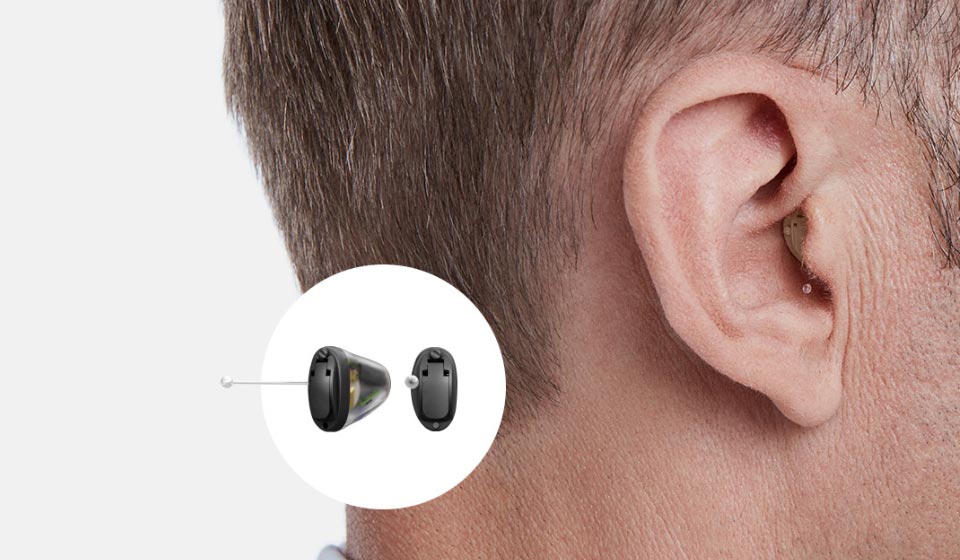
Man’s ear wearing a discreet invisible hearing aid, with a close-up of the device shown separately.

Invisible hearing aids

Modern hearing aids are more discreet than ever. In fact, there are now hearing aids available which are almost invisible to the eye. Learn how these miniature hearing aids provide both a discreet look and a high-quality listening experience.

group of people icon with blue and green accents
Helped over
30,000 New Zealander's
A blue calendar icon displays the number ’90’ in bold, centered on a white background under a green header, symbolizing a 90-day timeframe, possibly for a hearing aid trial or service.
90-day
money-back guarantee^

What are invisible hearing aids?

Invisible hearing aids sit inside your ear so that they are invisible to the naked eye. Perhaps most impressive is that the advanced digital technology in these hearing aids fits into such a small device.

Invisible hearing aids are custom-fitted to your ear canal, and they contain no external tubes and wires.

Types of hearing aids

Family_gathered_in_kitchen_talking

Introducing Oticon Zeal™

The latest advancement in hearing aid technology - Oticon Zeal™ is our smallest, full function hearing aid yet.
Discreet size - AI sound processing - Fast-pairing to your devices - Rechargeable, all-day battery - Get tested and fitted the same day^

Experience Oticon Zeal™ with our 90day money back guarantee**


Question 1 of 1
How do you prefer to book?
Book online

Discover the magic inside Oticon Zeal™

  • Combines discreet design with amazing sound.

  • Keeps you connected all day to your favourite people, places, and devices.

  • Long-lasting battery that can charge on the go.

  • Ready to wear the same day. Get tested and fitted on the spot.^

Invisible hearing aids: advantages and disadvantages

Several factores determine whether invisible hearing aids are suitable for you. The level of your hearing loss, the shape of your ear canal and your personal preferences about hearing aids are all factors, that should be considered. 

Below you can get overview of the most common pros and cons of invisible hearing aids.

 Advantages Disadvantages 
Small, discreet style  Shorter battery life 
Less likely to pick up wind noise  Controls are harder to see and feel 
More natural sound experience  Not suitable for all ear canal shapes 
No external tubes / wires Challenging to handle for those with dexterity issues  
Custom-fitted (more comfortable for most users) No binaural coordination possible between your two hearing aids 
  No Bluetooth® connectivity available
  Not available with rechargeable batteries 

FAQ about invisible hearing aids

katherine grey blouse green background hearing care expert
Katherine Bayly - Head of Audiology Clinical Governance and Quality

Audiologist MNZAS CCC, MAud(Hons) BSc

Katherine has worked in the audiology sector for over 20 years.   She began her audiology career in the public health system here in New Zealand, and has since gained a wide range of audiological skills,  having worked in paediatrics, diagnostics, cochlear implants, tinnitus counselling and within the hearing device industry.

With her broad experience Katherine has now taken on the role of Head of Audiology for Audika New Zealand. Katherine’s focus is on ensuring every client that Audika interacts with feels they have been provided with the best possible care; that they have been listened to and been treated with the highest level of care by all clinical team members. “At Audika we specialise in hearing care, so our aim is to ensure we provide truly personalised, comprehensive care from the moment our clients first walk in the door, right through to the regular check ups and reviews we continue to provide throughout their hearing journey”. 

^Applies to Demant hearing devices only (Oticon, Bernafon & Sonic brands, excludes accessories).